Go just about anywhere in the world and you can pick up a new Golf, but beyond that, Volkswagen offers individual models catered to local markets. European buyers can drive off in the Up!, South Americans can get their hands on the Saveiro, Chinese customers have the new Lamando at their disposal, and in India, VW offers the Vento. Essentially a Polo with a longer wheelbase and a trunk, the Vento is a bare-bones economy sedan, and it's just undergone a facelift. The updates are mostly familiar from the latest Polo, with sharper lines, new headlamps and a revised interior with three-spoke steering wheel. Powertrain options include a 1.2- and 1.6-liter gasoline engines and a 1.5-liter TDI, mated to either a five-speed manual or seven-speed automatic transmission, with trim levels including Trendline, Comfortline and Highline. Either way, you're looking at a fairly basic form of transportation, with only the top trim coming with features like stability management and dual front airbags.
Friday, August 8, 2014
Wednesday, August 6, 2014
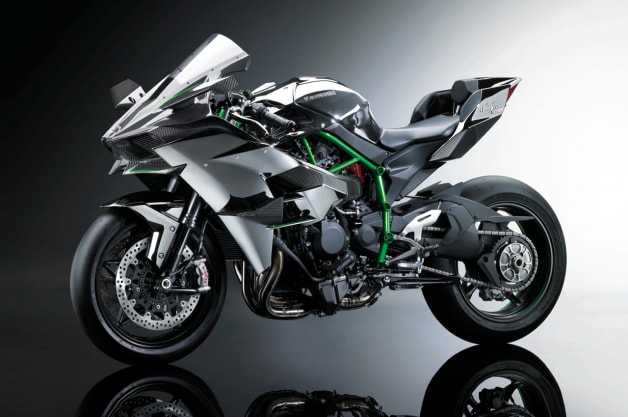
Kawasaki Ninja H2R is a 300-hp supercharged carbon-fiber cruise missile
We don't get to cover the ins and outs of the motorcycle world as much as we'd like, but there was no way we could skip bringing you the latest announcement of the Kawasaki Ninja H2R. Great Galloping Jesus, does this thing look incredible. The Ninja nameplate has typically been synonymous with top-tier performance, and this carbon fiber-clad monster seeks to take that reputation to another level. Crouched inside of that green, tubular steel trellis frame is a 998cc inline-four engine that has been supercharged to the tune of 300 horsepower. That unprecedented figure is almost guaranteed to carry the H2R well past the 200-mile per-hour-mark, for any test-rider brave enough to keep the throttle pegged and skillful enough to keep the 17-inch slicks stuck to the Earth. The new Ninja isn't a street-legal machine – as evidenced by its headlightless, bewinged face – but rather a showpiece for Kawasaki knowhow. A single-sided swingarm – a first for Kawasaki – holds the rear wheel in place, while the steel trellis takes up less space than would an aluminum twin-spar. The carbon-fiber work on the cowl was designed with assistance from the company's aerospace arm, while engineering of the centrifugal supercharger was aided by minds in the personal watercraft division. Teamwork makes the dream work, we always say. And this particular dream is expected to be come a streetable reality, we're told, at this year's EICMA show. The new Ninja formula is expected to be shown on a street bike debut at the event. Don't expect the consumer version to be as wild, and as wildly powerful, but we do anticipate it'll be impressive.
Tuesday, August 5, 2014
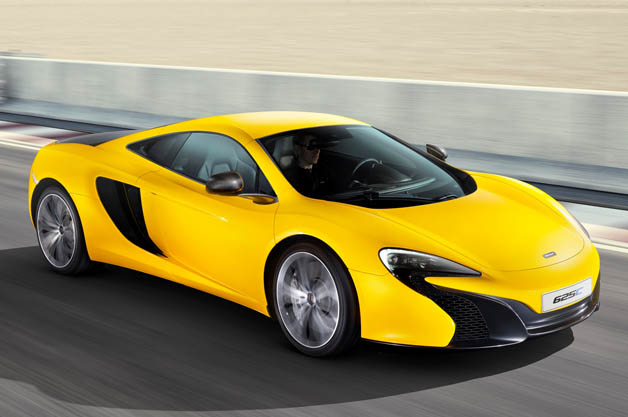
McLaren rolls out more accessible 625C in Asia
When McLaren first introduced the 650S, the initial idea was to keep the 12C it effectively replaced around as a more accessible option – particularly in certain Asian markets where buying a new car, much less an exotic supercar, is an even costlier endeavor than it is in other markets. Woking soon changed track and discontinued the 12C, but has now addressed that "entry-level" demand with the introduction of the new 625C. Based closely on the 650S, the 625C is being launched in Hong Kong and will be available exclusively in the Asia Pacific region, making this McLaren's first "regionally tailored" model. It's powered by McLaren's signature 3.8-liter twin-turbo V8, but carries the same 616-horsepower output as the 12C touted before it's demise. It also gets a softer rear suspension to make the Club model both "more refined and more accessible" than the 650S. As a result of the decrease in power, 0-62 is quoted at one tenth slower than the 650S at 3.1 seconds, while top speed and emissions figures remain the same. Asian buyers will be able to opt for coupe and convertible body-styles, but what's particularly interesting for those in other regions is that the 625C paves the way for other variants tailored to specific markets (say, like the North American one, for example) and that the nameplate ostensibly sets the precedent for a new naming scheme to usher McLaren away from its previous disparate nomenclature (12C, 650S, P1) and into a more clearly defined hierarchy.
Friday, July 25, 2014
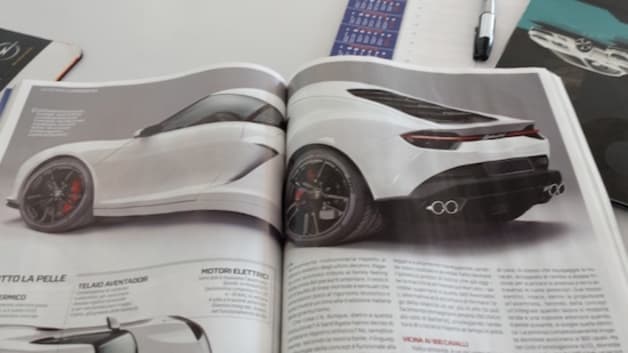
Lamborghini Asterion leaked in print ahead of Paris debut
The first purportedly leaked images from an Italian magazine of Lamborghini's new vehicle for the Paris Motor Show are on the web, and they closely echo the model's silhouette from the teaser. However, there's no official mention of a name to confirm that this is being called the Asterion, as rumored. The profile image (right) definitely suggests this is the same model that Lamborghini is previewing for Paris. It features the same slightly arcing hood and roof, and it has a rear air intake behind the door. The shape also seems to support the belief that this concept has a 2+2 seating arrangement to echo earlier Lambo models like Espada. According to Autoblog.nl, which has posted the images, the vehicle may use a hybrid V10 with three electric motors to produce in the neighborhood of 900 horsepower. Furthermore, it claims that this might be just one of two concepts that Lamborghini is bringing to the Paris show. For now it's still a mystery, but all should be revealed on October 2 for the vehicle's unveiling.
Friday, July 18, 2014
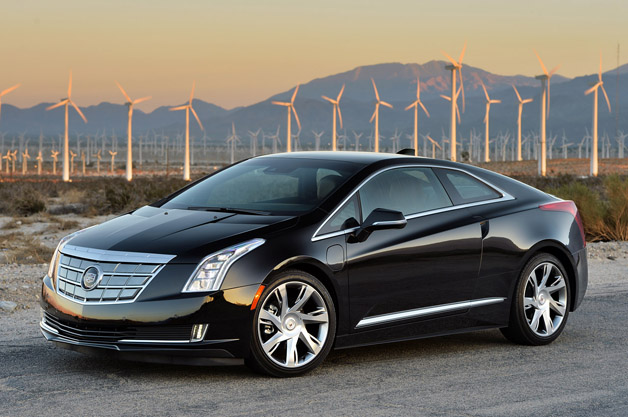
2014 Cadillac ELR
A few years ago, Audi Of America's boss Johan de Nysschen went on record describing the Chevrolet Volt as "a car for idiots." Fast-forward to earlier this summer, and the well-regarded executive suddenly found himself in a new office with new business cards bearing the title: President, Cadillac. That means that among other challenges, de Nysschen is now tasked with selling the ELR, a car that is, at its core, a Volt in a sportier, less utile frock wearing a price tag that's twice as expensive. Frankly, it's not a prospect we imagine the South African executive and recent Infiniti boss relishes. Just about nobody is buying the ELR – Cadillac has sold but 774 examples of its plug-in hybrid coupe this year and it presently has an almost a 200-day supply according to Automotive News. What's more, those numbers actually represent big improvements over just a few months ago, before GM started heaping on the incentives. The cynic in us says that the bad news for De Nysschen is that he's got a borderline sales-proof car in his new corporate garage. The good news? Cadillac customers apparently aren't idiots. Before we go any further, let's get back to that elephant in the room: price. There's no way to be kind here – General Motors has saddled its 2014 Cadillac ELR with a scarcely believable bottom line: $75,000. Even arithmophobes like us can work out that that means it costs as much as a base ATS Coupe and a Chevrolet Volt combined. That, in our book, is unforgivably bad math – the sort of computation logic understood only by buyers of the Aston Martin Cygnet, or perhaps those who signed off on the Allante's assembly process back in the '80s, an arrangement that involved flying uncompleted cars over the Atlantic in custom-outfitted Boeing 747s. Twice.
Wednesday, July 9, 2014
Cadillac planning its own engines, halo cars
Cadillac is in the midst of some big changes. It's got a new chief executive. It's taking some distance from parent company General Motors and moving to a new headquarters in New York. And it's instituting a new naming scheme that will allow not only for a more clear progression in its lineup, but also for more models. But that's not the end of the story. Not by a long shot. Speaking with Automobile magazine, Cadillac's new president Johan de Nysschen revealed his intention to develop several new models and powertrains. For starters, he does not want Cadillac to continue borrowing engines from the GM parts bin, but intends to develop a new range of engines specifically for the luxury automaker. The program will likely start with smaller-capacity engines but eventually lead to new V8s as well, taking the place of the long-serving Northstar engine that finally ended its lifespan a few years ago after some two decades of production. Along with other technologies, de Nysschen envisions possibly sharing these powertrains with other GM divisions, but developing them first and foremost for Cadillac. The bigger question, however, is where those engines would go, and de Nysschen had some thoughts to share on that front as well. For starters, the former Infiniti and Audi exec sees room for an even bigger sedan above the upcoming new CT6 that will cap the current range. Maybe even two of them. But that's not all. Johan wants to see Cadillac get (back) into the sports car game with a new halo model or two – something it hasn't really done since the Corvette-based XLR roadster. A pair of new crossovers are also said to be in the works, flanking the SRX on both sides with smaller and larger models. All of these plans de Nysschen hopes to get up and running within the next ten to fifteen years before he needs to retire. They're ambitious plans, to be certain, and paint a picture of a resurgent Cadillac that aims to once again become the world standard.
Tuesday, June 17, 2014
Pontiac Firebird in latest Generation Gap scrap
Generation Gap is mining the Lingenfelter collection again this week to compare two very different interpretations of the Pontiac Firebird. An original 1968 example goes toe-to-toe with a 2010 Lingenfelter Trans Am to see whether the old man or the modern re-imagining takes the crown. Being from the Lingenfelter collection, both cars are absolutely immaculate. The '68 packs a Pontiac 350-cubic-inch (5.7-liter) V8 with a claimed 320 horsepower and some classic, muscular style with a hood-mounted tach. Plus, it's painted in an understated shade of green that you don't usually see. In the other corner is Lingenfelter's pumped-up take on the classic shape based on the modern Camaro, and this is just one of six concept versions ever made. It wears an eye-catching, vintage-inspired livery of blue with a white stripe package. Under its shaker hood is a 455-cubic-inch (7.5-liter) V8 with a reported 655 hp and 610 pound-feet of torque. Watch the hosts drive them both in the video to see which one you'd choose. Both choices certainly have their advantages.
Subscribe to:
Posts (Atom)